Why Windows Fog Up in Illinois Winters — and When It's a Problem
Three kinds of window fog, what causes each, and the only one that needs a repair.
By Local Window Service · Published · 6 min read
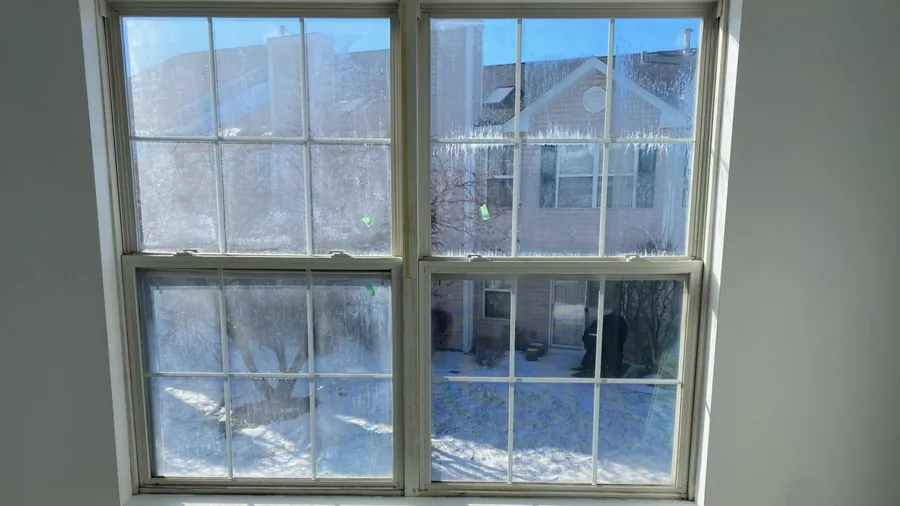
On a cold January morning, a lot of McHenry County windows look foggy. Most of the time that's harmless. Sometimes it means a seal has failed. Here's how to tell the difference in about ten seconds.
There are three places fog can form on a double-pane window: on the room side of the glass, on the outside surface, or between the two panes. Each has a completely different cause — and only one of them needs a repair.
1. Fog on the inside surface: too much indoor humidity
When warm, moist indoor air touches glass that's been chilled by sub-zero air outside, the moisture condenses into droplets — the same thing that happens to a cold drink on a summer day.
In Illinois winters, the inner pane of a window can easily drop below the dew point of indoor air, especially at the bottom edge of the glass, where it's coldest.
How to tell: wipe it with your finger from inside the room. If it wipes off, it's room-side condensation.
What to do: lower indoor humidity. Run bathroom and kitchen exhaust fans, avoid drying laundry indoors, don't over-humidify, and keep curtains slightly open so warm room air reaches the glass.
The colder it is outside, the lower indoor humidity needs to be to keep glass clear — a common rule of thumb is around 30–40% in a typical winter, and lower still during a deep cold snap. A small amount of condensation at the very bottom edge on the coldest mornings is normal.
2. Fog on the outside surface: a sign of efficient glass
On cool, humid mornings — especially in spring and fall — you may see fog on the outside of the glass. This happens because good insulated glass keeps the house's heat in, so the outer pane stays as cold as the outdoor air and dew forms on it, just as it does on a car windshield or the lawn.
How to tell: it wipes off from outside, and it usually burns off within an hour or two of sunrise.
What to do: nothing. It isn't a defect — it's evidence your glass is insulating well.
3. Fog between the panes: a failed seal
If the fog, haze or mineral streaks can't be wiped off from either side, they're inside the sealed glass unit. That means the seal around the edge of the unit has failed, humid outdoor air has leaked in between the panes, and the insulating gas has leaked out.
How to tell: it won't wipe off from either side. It often comes and goes with temperature and sun, and over time it leaves a permanent cloudy film or white spots.
What to do: replace the glass unit. You don't need a new window — the sealed unit can be replaced in the existing sash and frame, typically for $300–$800 per window, compared with $800–$2,500+ for a whole new window. See foggy window repair for how it works.
Why Illinois winters are so hard on window seals
The seal around an insulated glass unit flexes every time the temperature changes: the gas between the panes expands and contracts, and the glass bows very slightly in and out. Northern Illinois puts windows through wide seasonal swings and repeated freeze-thaw cycles, so seals here work harder than in milder climates.
That's why so many homes built during the 1990s and 2000s — across Lake in the Hills, Huntley, Algonquin and Crystal Lake — are seeing fogged units now. Seals on units from that era typically last 15 to 25 years, so many of them are failing now.
What about "defogging" services?
Some services drill small holes in the glass, dry out the space between the panes and seal the holes.
This can make the glass look clearer for a while, but it doesn't restore the failed edge seal or replace the lost insulating gas — so the window doesn't regain its insulating performance, and the fog often returns. Replacing the unit fixes the cause.
A quick decision guide
- Wipes off inside → lower indoor humidity. No repair needed.
- Wipes off outside → normal for efficient glass. No repair needed.
- Won't wipe off either side → the seal has failed. Replace the glass unit, not the window.
Facing a quote to replace the window instead? Our repair-or-replace flowchart helps you decide. Not sure which kind of fog you have? Take a photo on a cold morning and send it to us — we'll tell you, free.
- On the inside surface — indoor humidity condensing on cold glass. It wipes off from inside — lower the humidity. No repair needed.
- On the outside surface — dew on efficient glass on cool mornings. It wipes off from outside and burns off. Completely normal.
- Between the panes — the seal has failed. It won't wipe off from either side. The glass unit needs replacing — not the window.
Only number 3 needs a repair.
Fix the Window. Keep the Money.
Call, text, or send a photo. You'll know what's wrong and roughly what it costs — before anyone comes out.
★★★★★ 4.9 from 145+ reviews · 20-year glass warranty · Price match